The lamb is served and now it’s time to complete the feast. From flavour-packed savoury sides to decadent sweet bakes, the Irish Country Living Food test kitchen has taken global flavour inspiration with these recipes, starting off with some traditional French madeleines.
To get the perfect madeleine (complete with its signature “bump”), make sure everything is well chilled and the batter has had time to rest before baking.
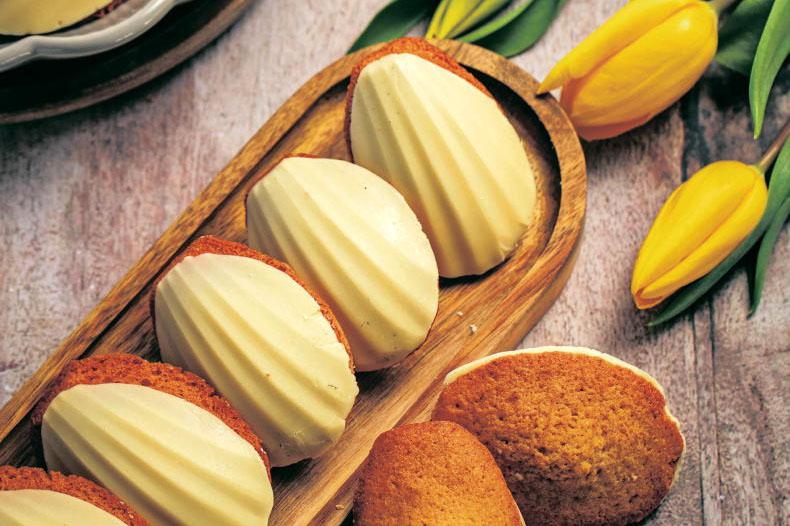
Lemon, brown butter and white chocolate madeleines
Makes approximately 24
Ingredients
115g butter
(plus extra for brushing the tray)2 large eggs100g caster sugar1 ½ tsp vanilla extractRind of 1 lemon115g plain flour½ tsp baking powder¼ tsp salt200g good quality white chocolate1 tbsp coconut oilMethod
1 Place the butter in a saucepan and gently simmer until it starts to brown and foam, about 5 minutes. Remove from the heat and let cool.
2 In a large bowl (or the bowl of a stand mixer), add the sugar and eggs. Using the paddle attachment in your stand mixer, or using a hand mixer, whip the sugar and eggs for 8-10 minutes, until pale in colour and more than doubled in volume. Add the lemon rind and vanilla and mix to combine.
3 In another bowl, sift the flour, baking powder and salt. Using a spatula, gently fold the flour mixture into the whipped egg and sugar mixture (try not to let out too much air). Then, add this mixture to the browned butter and, again, gently fold to incorporate.
4 Place this mixture into a piping bag and chill for 2-3 hours in the fridge.
5 Preheat the oven to 180°C and, while the oven is preheating, brush a madeleine pan (you can buy them online or in kitchen shops) with melted butter. Place in the freezer for 20 minutes to chill completely. You need cold batter and a cold tin to create the perfect madeleine.
6 When the oven is preheated, pipe approximately 1 heaped tablespoon of batter into each madeleine mould. Place in the oven and bake for 10-12 minutes. The madeleines should be golden brown all over with a rounded “bump” on one side. Cool completely and remove from the tin. Butter, chill and repeat this process until all the batter is used.
7 When the madeleines are baked and cooled, place the white chocolate and coconut oil in a microwave-safe bowl. Microwave the mixture for 1 minute, then stir. If it doesn’t melt completely, place it back in the microwave for 30 second intervals until it is melted and completely smooth.
8 Place 1 heaped tablespoon of the melted white chocolate mixture into a madeleine mould and place a baked madeleine on top, pushing it down slightly to help spread the chocolate evenly. Do this with each madeleine mould and when all 12 are filled, place the tin in the freezer for 10-15 minutes.
9 Pop each chocolate-covered madeleine out of the tin and repeat with the remaining white chocolate and madeleines until each madeleine in coated in the white chocolate mixture. The seashell imprint should be clearly visible and the white chocolate, once set, should be shiny and smooth.
10 Serve immediately or keep in an airtight container for up to three days. These madeleines have a cakey texture and go perfectly with a cuppa.
Rhubarb sour cream crumble tart
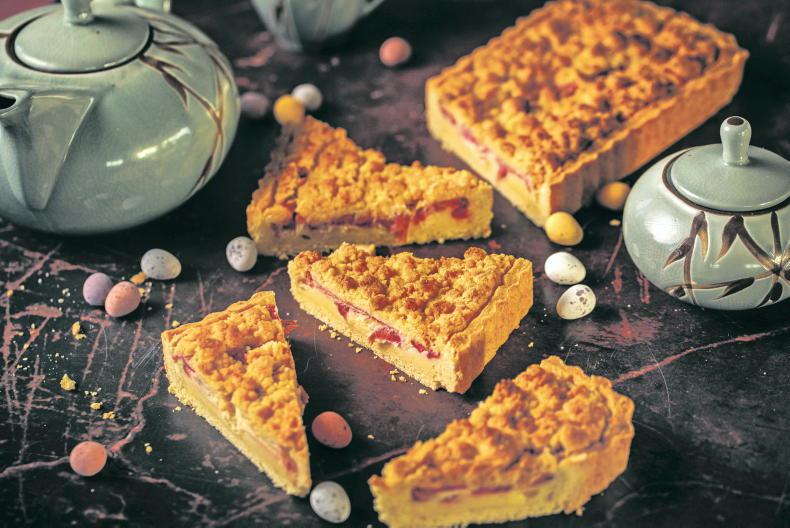
Rhubarb sour cream crumble tart.
You might think sour cream paired with rhubarb will result in too much tartness, but trust us – these flavours are entirely complementary. With the right amount of sugar and vanilla to make this a truly indulgent dessert, your dinner companions will be asking for second helpings.
Makes 2 tarts
Ingredients
For the pastry:
215g butter, cold and cubed360g plain flour25g caster sugar1 large egg1 tsp saltFor the crumble topping:
185g plain flour125g light brown sugar125g butter, cold and cubedFor the sour cream filling:
365g sour cream250g caster sugarRind of 1 lemon1 tsp vanilla bean paste1 large egg30g cornflour500g fresh rhubarb, washed and dicedMethod
1 First, make the pastry: in a large bowl, whisk the flour, salt and caster sugar to combine. Add the cold butter and, using your fingers, rub the butter into the flour mixture until the mixture resembles coarse crumbs.
2 Add the egg to the flour and butter mixture and, again using your hands, mix to combine. The resulting dough should be soft and pliable, but not sticky. Form the pastry into two even sized discs.
3 Roll the dough out onto a lightly floured surface and place into a loose-bottomed 20cm tart tin (we used a rectangular 36cm tart tin for this recipe, but any tin will do). Press the dough into the tin, leaving a bit hanging over the edges, and chill for a minimum of 1 hour (preferably 2-3 hours). If you’re making two tarts, repeat this process with the other disc of dough (the other disc can also be frozen and used at a later time).
4 While the dough is chilling, make the crumble topping: in a large mixing bowl, combine the flour, brown sugar and butter. Using your fingers, rub the mixture together until it is well combined and creates a natural crumble. Place this mixture in the fridge to chill while you make the filling.
5 Preheat the oven to 190°C while you make the sour cream filling: in a large bowl, combine the sour cream, caster sugar, vanilla, lemon rind, egg and cornflour.
6 Remove the tart dough from the fridge and, using a knife, trim any excess dough from the sides. Pour half of the sour cream mixture into the pastry base and top with half the rhubarb, then top the rhubarb with half the crumble mixture.Repeat with the remaining ingredients for the second tart (or, again, all of these components can be frozen and used at a later time).
7 Place the tarts on baking trays into the preheated oven. Bake the tarts for approximately 40 minutes, or until the crumble topping and pastry is golden brown and the filling is cooked through but still has a slight wobble.
Cool the tarts completely before slicing and serving with fresh custard.
Spaetzle with goat’s cheese, spring herbs and caramelised onion
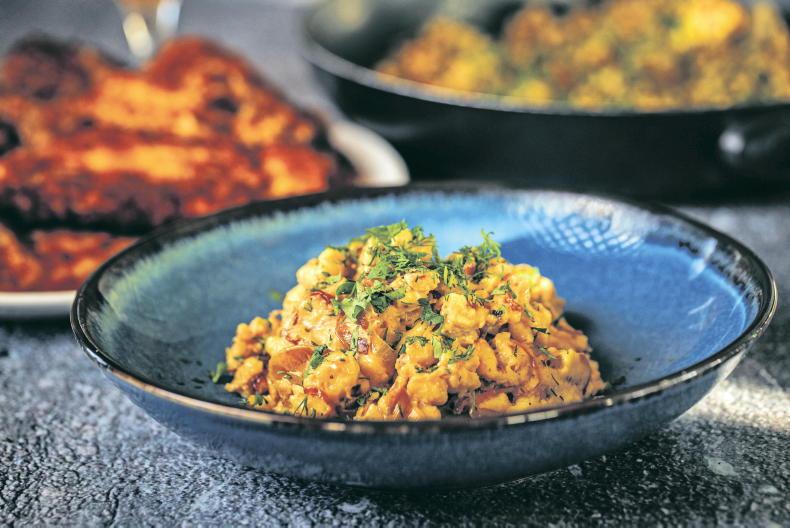
Spaetzle with goat’s cheese, spring herbs and caramelised onion.
Spaetzle is a type of noodle made with an eggy batter, similar in consistency to an American-style pancake batter. You make the noodles by pushing the batter through a colander directly into salted, boiling water. Combined with caramelised onion and goat’s cheese, it’s the perfect side dish for slow roasted meats (like Easter lamb).
Serves 6-8
Ingredients
360g plain flour 2 tsp sea salt 1 tsp freshly ground black pepper 6 large eggs, lightly beaten 125ml milk 1 tbsp grainy mustard 6 large onions, thinly sliced 2 tbsp butter (plus more for caramelising the onions) 150g soft Irish goat’s cheese, like St Tola or Ardsallagh More salt and pepper, to taste 100g finely chopped chives, flat leaf parsley and dill Method
1 Make the spaetzle batter: in a large bowl, add the flour, salt, pepper, eggs, milk and grainy mustard. Mix well with a whisk for 3-4 minutes. This will look a bit like a pancake batter, but unlike a pancake batter, you want to over-mix this to build up the gluten. Mix the batter until it starts to resist and the gluten has started to develop. Then, leave the batter to rest at room temperature for around 30 minutes.
2 Bring a large pot of water to a boil and season generously with sea salt. Set yourself up for spaetzle success: line a baking tray with a clean dish towel for the cooked spaetzle. Have a colander and spatula next to the pot and also a plate to rest the colander and spatula on when not being used (to avoid the batter getting everywhere). Have a slotted spoon handy (for scooping the cooked spaetzle out of the water) and a large serving spoon in the bowl of batter (we used a portion controlling scoop for this).
3 Place 1-2 large scoops of batter into the colander and, working quickly, place the colander directly over the boiling water. Start working the batter through the holes of the colander with the spatula. As they fall into the boiling water they will immediately form into small noodles and will cook in just 1-2 minutes. Once all of the batter has been passed through the colander, put the colander down onto the plate and, using the slotted spoon, scoop the cooked spaetzle out of the water. Place onto the dish towel-lined baking tray to cool. Repeat this process until all of the spaetzle are cooked.
4 When the spaetzle is cooked, leave to cool at room temperature while you caramelise the onions: slice the onions as thinly as possible. Melt the butter in a stainless steel frying pan over medium heat and add all of the sliced onions at once. Cook slowly for approximately 40 minutes – at first, the onions will become translucent, then they will start to colour a bit and eventually they will turn a dark brown and caramelise nicely. You will want to stir the onions every 10 minutes or so. Reduce the heat if they are browning too quickly.
5 When the onions are caramelised, add the spaetzle into the same pan. Heat the spaetzle through and mix well with the caramelised onions. Crumble the soft goat cheese into the mixture and stir until completely melted. Season with salt and pepper.
6 Just before serving, sprinkle the spaetzle with finely chopped flat leaf parsley, dill and chives. This is a wonderful side dish for pork, veal or lamb.
Breaded veal escalopes with lemon caper butter
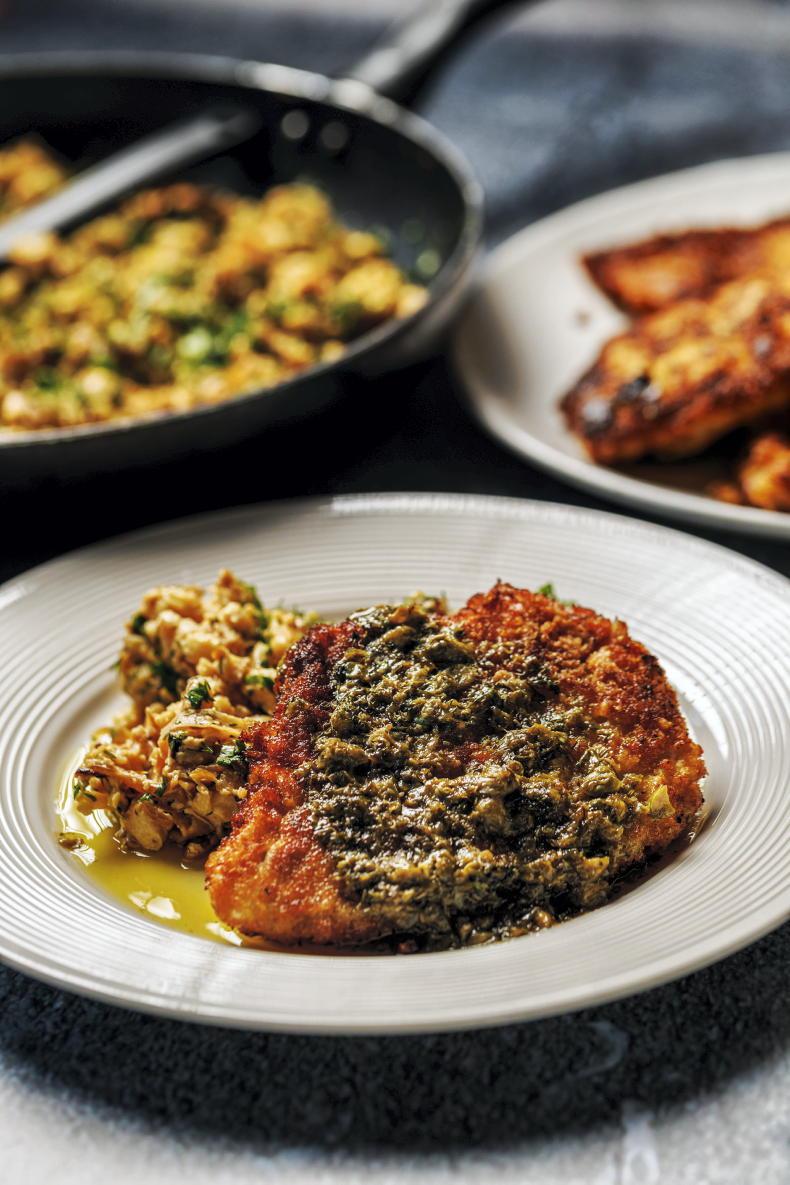
Breaded veal escalopes with lemon caper butter. / Philip Doyle
Irish rose veal is ethically raised to the Irish grass-fed standard, and is absolutely delicious if you are looking for something a bit different this Easter. Some butchers offer veal regularly, and most will order some in if you request it. If you don’t want to use veal, you can also use
chicken or pork medallions for this recipe.
Serves 6
Ingredients
6 veal escalopes Salt and pepper, to taste 2 eggs, lightly beaten 100g plain flour 250g breadcrumbs 200ml vegetable oil For the lemon caper butter
6 tbsp cold, cubed butter 1 shallot, finely chopped 200ml white wine Juice of one lemon 1 tbsp capers, finely chopped 2 tbsp flat leaf parsley, finely chopped Salt and pepper, to taste Method
1 Set up your breading station: first, line a baking sheet with parchment paper and set aside until ready to use. Set up three bowls and in one, place the lightly beaten eggs. In the second, place the flour and in the third, place the breadcrumbs.
2 Pat the veal escalopes dry with kitchen towel and season well with salt and pepper. Dip each escalope first in the flour, then the egg and finally the breadcrumbs, pressing down lightly to ensure an even coating. Once each escalope is breaded, place them on the lined baking sheet and refrigerate for at least 1 hour.
3 When ready to fry, heat the vegetable oil in a large frying pan over medium-high heat. When the oil is hot, reduce the heat to medium and carefully place 1-2 escalopes (depending on the size of the pan) in the pan. Fry each escalope in the oil until golden brown all over, approximately 5 minutes on each side. Once fried, place the escalopes on a tray lined with kitchen towel to absorb any excess oil. Lightly season the fried escalopes with a bit of flaky sea salt. Keep warm in the oven while making the sauce.
4 Make the lemon caper butter: in a pan, melt 2 tbsp of the butter and add the finely chopped shallot. Cook on a medium heat for 3-4 minutes, or until the shallot is softened but not browned. Add the white wine and lemon juice. Cook until the liquid is reduced by half, then add the remaining cold, cubed butter and whisk to make a sauce. Add in the capers and parsley. Taste and adjust the seasoning with salt and pepper, if needed.
5 Serve the escalopes with the warm lemon caper butter.
This recipe is perfect paired with the spaetzle, bulgur wheat and asparagus for a more formal Easter gathering, but it’s also great with some creamy mashed potatoes and peas.
Bulgur wheat salad with preserved lemon, mint and peas
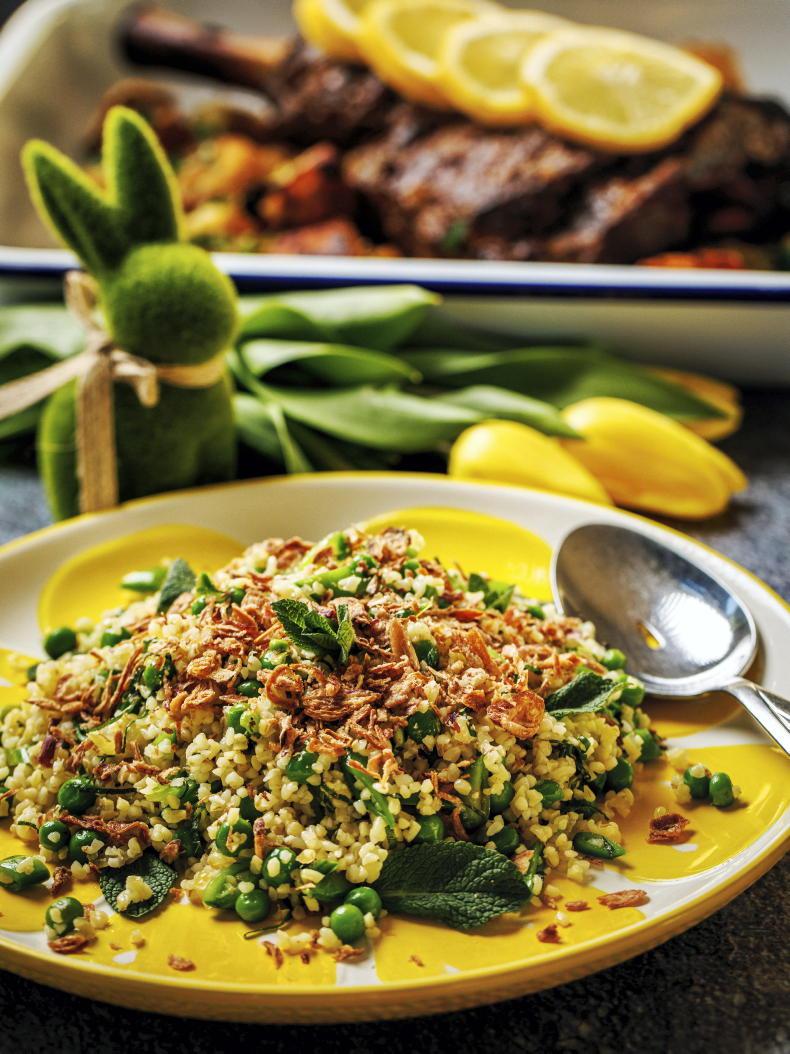
Bulgur wheat salad with preserved lemon, mint and peas./Philip Doyle
Preserved lemon is a common ingredient in Middle Eastern and North African cuisines, They are often used in dishes like tagines and salads, adding a unique flavour profile that is both tangy and citrusy. You can have them delivered directly to your door anywhere in Ireland (we got ours from Sheridan’s Cheesemongers - Odysea Preserved Lemon 200g for €3.60).
Preserved lemon rind offers a deeply aromatic flavour which pairs especially well with vibrant green vegetables, like peas, green beans or asparagus. Bulgur wheat is a very forgiving grain to work with; it just requires 5-10 minutes of cooking. Once cooked, it will absorb the flavours of the salad nicely.
This recipe is best made the day before and left in the fridge to let those flavours develop. Add the mint and crispy shallots before you serve.
Serves 8-10
Ingredients
250g bulgur wheat 200g garden peas, frozen 200g sugar snap peas 2 preserved lemons, insides discarded and peel finely chopped 50g fresh mint, finely chopped 50ml good quality olive oil 1 tbsp red wine vinegar 1 tsp Dijon mustard 1 small clove garlic, minced Salt and pepper, to taste Crispy fried shallots or onions (shop bought)
Method
1 Bring a pot of salted water to a rapid boil and add the bulgur wheat. Cook for 5-10 minutes, until the bulgur wheat is just tender – not mushy or overcooked. Strain the bulgur wheat into a fine sieve (the smaller grains will fall through a regular colander) and spread out onto a clean baking tray to cool at room temperature.
2 Fill a mixing bowl with cold water. Add several ice cubes to make the water as cold as possible and set aside. Bring another pot of water to a rapid boil. Wash the sugar snap peas and then add to the boiling water. Cook for just 1-2 minutes – when the peas turn bright green, they are finished. Use a slotted spoon to remove them from the boiling water and immediately plunge them in the ice water to stop the cooking process (this is called blanching).
3 Repeat this process with the frozen peas – add them to the boiling water, cook until they turn bright green and then plunge them into the ice water. When the peas and sugar snap peas are completely chilled, take them out of the ice water. Slice the sugar snap peas into bite-size pieces and let them drain on a baking sheet lined with a clean dish towel.
4 When the bulgur wheat is completely cool, add it to a large mixing bowl. Finely chop the preserved lemon peel and add to the bulgur wheat, then add the finely chopped mint and the green vegetables. Mix well.
5 Make a quick vinaigrette by mixing the olive oil, red wine vinegar, Dijon mustard and minced garlic. Drizzle over the bulgur wheat and then season with salt and pepper. Mix well and check the seasoning, adding more salt and pepper, if needed.
6 To serve, spread the salad over a large plate or platter and top with more fresh mint and a big handful of shop-bought crispy fried shallots or onions.
Griddled new season asparagus with roasted garlic aioli, toasted hazelnuts and Cais na Tire
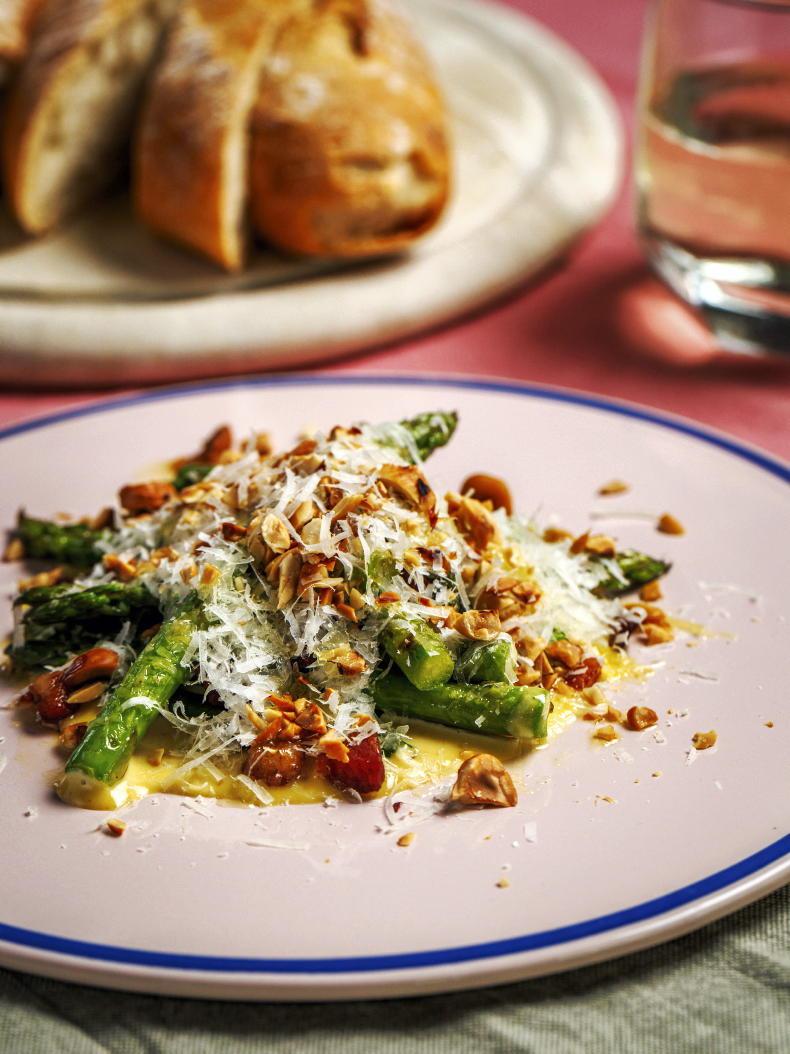
Griddled new season asparagus with roasted garlic aioli, toasted hazelnuts and Cais na Tire. / Philip Doyle
This is a true taste of the Irish spring, especially if you can get your hands on some local new season asparagus. Irish garlic is available in select supermarkets around the country, as is Cais na Tire – a delicious sheep’s milk cheese made in Co Tipperary. We like to use Cais na Tire where we might otherwise be tempted to use Parmigiano Reggiano – especially when there are fresh, crunchy veggies involved.
Serves 6
Ingredients
For the aioli:
1 bulb Irish garlic 2 egg yolks Juice from ½ lemon 1 tsp Dijon mustard 75ml good quality olive oil 75ml mild flavoured oil, like sunflower 1-2 tbsp boiling water Salt and pepper, to taste For the asparagus:
50g pancetta or streaky bacon, cut into bite-size pieces 200g whole hazelnuts 50g Cais na Tire cheese, finely grated 1 tbsp olive oil500g new season asparagus, washed and ends removed Method
1 Make the roasted garlic aioli: preheat the oven to 180°C. Using a serrated knife, cut off the top of the entire bulb of garlic (keeping all of the cloves attached and intact). Place the bulb on a piece of foil, drizzle the top with a bit of olive oil and wrap the bulb in the foil. Roast in the oven for 30-40 minutes. Cool completely and then squeeze the cloves of roasted garlic out of the bulb. They should slide right out of the top.
2 Add the cooled roasted garlic to a glass measuring jug. Then, add the lemon juice, Dijon mustard and egg yolks. Using a hand blender, blend this mixture until well combined. Leave the hand blender sitting in the glass measuring jug and add the two oils all at once. Turn on the hand blender while submerged in the oil and the aioli will come together to become a thick, mayo-like consistency.
3 Add a splash of the boiling water to thin the consistency out a bit (so you can drizzle the aioli over the asparagus), season to taste with salt and pepper and refrigerate until ready to use (the aioli can be made 2-3 days in advance).
4 Keep the oven preheated at 180°C. Place the hazelnuts on a parchment-lined baking tray and roast in the oven for 10 minutes until nicely toasted. Let cool, then roughly chop the nuts and set aside.
5 Add the pancetta to a pan with a bit of water (the water will help render the fat) and place on medium high heat. Cook until the water is evaporated and the pancetta is crispy. Drain on some kitchen towel and keep warm until ready to use.
6 Toss the asparagus in 1 tbsp of olive oil and season with salt and pepper. Heat a griddle pan (or your barbecue) until smoking hot and add the asparagus in batches until lightly charred and cooked through. Place the cooked asparagus on a platter and drizzle over the roasted garlic aioli, then add the toasted hazelnuts, warm pancetta and Cais na Tire cheese. Serve immediately.
The lamb is served and now it’s time to complete the feast. From flavour-packed savoury sides to decadent sweet bakes, the Irish Country Living Food test kitchen has taken global flavour inspiration with these recipes, starting off with some traditional French madeleines.
To get the perfect madeleine (complete with its signature “bump”), make sure everything is well chilled and the batter has had time to rest before baking.
Lemon, brown butter and white chocolate madeleines
Makes approximately 24
Ingredients
115g butter
(plus extra for brushing the tray)2 large eggs100g caster sugar1 ½ tsp vanilla extractRind of 1 lemon115g plain flour½ tsp baking powder¼ tsp salt200g good quality white chocolate1 tbsp coconut oilMethod
1 Place the butter in a saucepan and gently simmer until it starts to brown and foam, about 5 minutes. Remove from the heat and let cool.
2 In a large bowl (or the bowl of a stand mixer), add the sugar and eggs. Using the paddle attachment in your stand mixer, or using a hand mixer, whip the sugar and eggs for 8-10 minutes, until pale in colour and more than doubled in volume. Add the lemon rind and vanilla and mix to combine.
3 In another bowl, sift the flour, baking powder and salt. Using a spatula, gently fold the flour mixture into the whipped egg and sugar mixture (try not to let out too much air). Then, add this mixture to the browned butter and, again, gently fold to incorporate.
4 Place this mixture into a piping bag and chill for 2-3 hours in the fridge.
5 Preheat the oven to 180°C and, while the oven is preheating, brush a madeleine pan (you can buy them online or in kitchen shops) with melted butter. Place in the freezer for 20 minutes to chill completely. You need cold batter and a cold tin to create the perfect madeleine.
6 When the oven is preheated, pipe approximately 1 heaped tablespoon of batter into each madeleine mould. Place in the oven and bake for 10-12 minutes. The madeleines should be golden brown all over with a rounded “bump” on one side. Cool completely and remove from the tin. Butter, chill and repeat this process until all the batter is used.
7 When the madeleines are baked and cooled, place the white chocolate and coconut oil in a microwave-safe bowl. Microwave the mixture for 1 minute, then stir. If it doesn’t melt completely, place it back in the microwave for 30 second intervals until it is melted and completely smooth.
8 Place 1 heaped tablespoon of the melted white chocolate mixture into a madeleine mould and place a baked madeleine on top, pushing it down slightly to help spread the chocolate evenly. Do this with each madeleine mould and when all 12 are filled, place the tin in the freezer for 10-15 minutes.
9 Pop each chocolate-covered madeleine out of the tin and repeat with the remaining white chocolate and madeleines until each madeleine in coated in the white chocolate mixture. The seashell imprint should be clearly visible and the white chocolate, once set, should be shiny and smooth.
10 Serve immediately or keep in an airtight container for up to three days. These madeleines have a cakey texture and go perfectly with a cuppa.
Rhubarb sour cream crumble tart
Rhubarb sour cream crumble tart.
You might think sour cream paired with rhubarb will result in too much tartness, but trust us – these flavours are entirely complementary. With the right amount of sugar and vanilla to make this a truly indulgent dessert, your dinner companions will be asking for second helpings.
Makes 2 tarts
Ingredients
For the pastry:
215g butter, cold and cubed360g plain flour25g caster sugar1 large egg1 tsp saltFor the crumble topping:
185g plain flour125g light brown sugar125g butter, cold and cubedFor the sour cream filling:
365g sour cream250g caster sugarRind of 1 lemon1 tsp vanilla bean paste1 large egg30g cornflour500g fresh rhubarb, washed and dicedMethod
1 First, make the pastry: in a large bowl, whisk the flour, salt and caster sugar to combine. Add the cold butter and, using your fingers, rub the butter into the flour mixture until the mixture resembles coarse crumbs.
2 Add the egg to the flour and butter mixture and, again using your hands, mix to combine. The resulting dough should be soft and pliable, but not sticky. Form the pastry into two even sized discs.
3 Roll the dough out onto a lightly floured surface and place into a loose-bottomed 20cm tart tin (we used a rectangular 36cm tart tin for this recipe, but any tin will do). Press the dough into the tin, leaving a bit hanging over the edges, and chill for a minimum of 1 hour (preferably 2-3 hours). If you’re making two tarts, repeat this process with the other disc of dough (the other disc can also be frozen and used at a later time).
4 While the dough is chilling, make the crumble topping: in a large mixing bowl, combine the flour, brown sugar and butter. Using your fingers, rub the mixture together until it is well combined and creates a natural crumble. Place this mixture in the fridge to chill while you make the filling.
5 Preheat the oven to 190°C while you make the sour cream filling: in a large bowl, combine the sour cream, caster sugar, vanilla, lemon rind, egg and cornflour.
6 Remove the tart dough from the fridge and, using a knife, trim any excess dough from the sides. Pour half of the sour cream mixture into the pastry base and top with half the rhubarb, then top the rhubarb with half the crumble mixture.Repeat with the remaining ingredients for the second tart (or, again, all of these components can be frozen and used at a later time).
7 Place the tarts on baking trays into the preheated oven. Bake the tarts for approximately 40 minutes, or until the crumble topping and pastry is golden brown and the filling is cooked through but still has a slight wobble.
Cool the tarts completely before slicing and serving with fresh custard.
Spaetzle with goat’s cheese, spring herbs and caramelised onion
Spaetzle with goat’s cheese, spring herbs and caramelised onion.
Spaetzle is a type of noodle made with an eggy batter, similar in consistency to an American-style pancake batter. You make the noodles by pushing the batter through a colander directly into salted, boiling water. Combined with caramelised onion and goat’s cheese, it’s the perfect side dish for slow roasted meats (like Easter lamb).
Serves 6-8
Ingredients
360g plain flour 2 tsp sea salt 1 tsp freshly ground black pepper 6 large eggs, lightly beaten 125ml milk 1 tbsp grainy mustard 6 large onions, thinly sliced 2 tbsp butter (plus more for caramelising the onions) 150g soft Irish goat’s cheese, like St Tola or Ardsallagh More salt and pepper, to taste 100g finely chopped chives, flat leaf parsley and dill Method
1 Make the spaetzle batter: in a large bowl, add the flour, salt, pepper, eggs, milk and grainy mustard. Mix well with a whisk for 3-4 minutes. This will look a bit like a pancake batter, but unlike a pancake batter, you want to over-mix this to build up the gluten. Mix the batter until it starts to resist and the gluten has started to develop. Then, leave the batter to rest at room temperature for around 30 minutes.
2 Bring a large pot of water to a boil and season generously with sea salt. Set yourself up for spaetzle success: line a baking tray with a clean dish towel for the cooked spaetzle. Have a colander and spatula next to the pot and also a plate to rest the colander and spatula on when not being used (to avoid the batter getting everywhere). Have a slotted spoon handy (for scooping the cooked spaetzle out of the water) and a large serving spoon in the bowl of batter (we used a portion controlling scoop for this).
3 Place 1-2 large scoops of batter into the colander and, working quickly, place the colander directly over the boiling water. Start working the batter through the holes of the colander with the spatula. As they fall into the boiling water they will immediately form into small noodles and will cook in just 1-2 minutes. Once all of the batter has been passed through the colander, put the colander down onto the plate and, using the slotted spoon, scoop the cooked spaetzle out of the water. Place onto the dish towel-lined baking tray to cool. Repeat this process until all of the spaetzle are cooked.
4 When the spaetzle is cooked, leave to cool at room temperature while you caramelise the onions: slice the onions as thinly as possible. Melt the butter in a stainless steel frying pan over medium heat and add all of the sliced onions at once. Cook slowly for approximately 40 minutes – at first, the onions will become translucent, then they will start to colour a bit and eventually they will turn a dark brown and caramelise nicely. You will want to stir the onions every 10 minutes or so. Reduce the heat if they are browning too quickly.
5 When the onions are caramelised, add the spaetzle into the same pan. Heat the spaetzle through and mix well with the caramelised onions. Crumble the soft goat cheese into the mixture and stir until completely melted. Season with salt and pepper.
6 Just before serving, sprinkle the spaetzle with finely chopped flat leaf parsley, dill and chives. This is a wonderful side dish for pork, veal or lamb.
Breaded veal escalopes with lemon caper butter
Breaded veal escalopes with lemon caper butter. / Philip Doyle
Irish rose veal is ethically raised to the Irish grass-fed standard, and is absolutely delicious if you are looking for something a bit different this Easter. Some butchers offer veal regularly, and most will order some in if you request it. If you don’t want to use veal, you can also use
chicken or pork medallions for this recipe.
Serves 6
Ingredients
6 veal escalopes Salt and pepper, to taste 2 eggs, lightly beaten 100g plain flour 250g breadcrumbs 200ml vegetable oil For the lemon caper butter
6 tbsp cold, cubed butter 1 shallot, finely chopped 200ml white wine Juice of one lemon 1 tbsp capers, finely chopped 2 tbsp flat leaf parsley, finely chopped Salt and pepper, to taste Method
1 Set up your breading station: first, line a baking sheet with parchment paper and set aside until ready to use. Set up three bowls and in one, place the lightly beaten eggs. In the second, place the flour and in the third, place the breadcrumbs.
2 Pat the veal escalopes dry with kitchen towel and season well with salt and pepper. Dip each escalope first in the flour, then the egg and finally the breadcrumbs, pressing down lightly to ensure an even coating. Once each escalope is breaded, place them on the lined baking sheet and refrigerate for at least 1 hour.
3 When ready to fry, heat the vegetable oil in a large frying pan over medium-high heat. When the oil is hot, reduce the heat to medium and carefully place 1-2 escalopes (depending on the size of the pan) in the pan. Fry each escalope in the oil until golden brown all over, approximately 5 minutes on each side. Once fried, place the escalopes on a tray lined with kitchen towel to absorb any excess oil. Lightly season the fried escalopes with a bit of flaky sea salt. Keep warm in the oven while making the sauce.
4 Make the lemon caper butter: in a pan, melt 2 tbsp of the butter and add the finely chopped shallot. Cook on a medium heat for 3-4 minutes, or until the shallot is softened but not browned. Add the white wine and lemon juice. Cook until the liquid is reduced by half, then add the remaining cold, cubed butter and whisk to make a sauce. Add in the capers and parsley. Taste and adjust the seasoning with salt and pepper, if needed.
5 Serve the escalopes with the warm lemon caper butter.
This recipe is perfect paired with the spaetzle, bulgur wheat and asparagus for a more formal Easter gathering, but it’s also great with some creamy mashed potatoes and peas.
Bulgur wheat salad with preserved lemon, mint and peas
Bulgur wheat salad with preserved lemon, mint and peas./Philip Doyle
Preserved lemon is a common ingredient in Middle Eastern and North African cuisines, They are often used in dishes like tagines and salads, adding a unique flavour profile that is both tangy and citrusy. You can have them delivered directly to your door anywhere in Ireland (we got ours from Sheridan’s Cheesemongers - Odysea Preserved Lemon 200g for €3.60).
Preserved lemon rind offers a deeply aromatic flavour which pairs especially well with vibrant green vegetables, like peas, green beans or asparagus. Bulgur wheat is a very forgiving grain to work with; it just requires 5-10 minutes of cooking. Once cooked, it will absorb the flavours of the salad nicely.
This recipe is best made the day before and left in the fridge to let those flavours develop. Add the mint and crispy shallots before you serve.
Serves 8-10
Ingredients
250g bulgur wheat 200g garden peas, frozen 200g sugar snap peas 2 preserved lemons, insides discarded and peel finely chopped 50g fresh mint, finely chopped 50ml good quality olive oil 1 tbsp red wine vinegar 1 tsp Dijon mustard 1 small clove garlic, minced Salt and pepper, to taste Crispy fried shallots or onions (shop bought)
Method
1 Bring a pot of salted water to a rapid boil and add the bulgur wheat. Cook for 5-10 minutes, until the bulgur wheat is just tender – not mushy or overcooked. Strain the bulgur wheat into a fine sieve (the smaller grains will fall through a regular colander) and spread out onto a clean baking tray to cool at room temperature.
2 Fill a mixing bowl with cold water. Add several ice cubes to make the water as cold as possible and set aside. Bring another pot of water to a rapid boil. Wash the sugar snap peas and then add to the boiling water. Cook for just 1-2 minutes – when the peas turn bright green, they are finished. Use a slotted spoon to remove them from the boiling water and immediately plunge them in the ice water to stop the cooking process (this is called blanching).
3 Repeat this process with the frozen peas – add them to the boiling water, cook until they turn bright green and then plunge them into the ice water. When the peas and sugar snap peas are completely chilled, take them out of the ice water. Slice the sugar snap peas into bite-size pieces and let them drain on a baking sheet lined with a clean dish towel.
4 When the bulgur wheat is completely cool, add it to a large mixing bowl. Finely chop the preserved lemon peel and add to the bulgur wheat, then add the finely chopped mint and the green vegetables. Mix well.
5 Make a quick vinaigrette by mixing the olive oil, red wine vinegar, Dijon mustard and minced garlic. Drizzle over the bulgur wheat and then season with salt and pepper. Mix well and check the seasoning, adding more salt and pepper, if needed.
6 To serve, spread the salad over a large plate or platter and top with more fresh mint and a big handful of shop-bought crispy fried shallots or onions.
Griddled new season asparagus with roasted garlic aioli, toasted hazelnuts and Cais na Tire
Griddled new season asparagus with roasted garlic aioli, toasted hazelnuts and Cais na Tire. / Philip Doyle
This is a true taste of the Irish spring, especially if you can get your hands on some local new season asparagus. Irish garlic is available in select supermarkets around the country, as is Cais na Tire – a delicious sheep’s milk cheese made in Co Tipperary. We like to use Cais na Tire where we might otherwise be tempted to use Parmigiano Reggiano – especially when there are fresh, crunchy veggies involved.
Serves 6
Ingredients
For the aioli:
1 bulb Irish garlic 2 egg yolks Juice from ½ lemon 1 tsp Dijon mustard 75ml good quality olive oil 75ml mild flavoured oil, like sunflower 1-2 tbsp boiling water Salt and pepper, to taste For the asparagus:
50g pancetta or streaky bacon, cut into bite-size pieces 200g whole hazelnuts 50g Cais na Tire cheese, finely grated 1 tbsp olive oil500g new season asparagus, washed and ends removed Method
1 Make the roasted garlic aioli: preheat the oven to 180°C. Using a serrated knife, cut off the top of the entire bulb of garlic (keeping all of the cloves attached and intact). Place the bulb on a piece of foil, drizzle the top with a bit of olive oil and wrap the bulb in the foil. Roast in the oven for 30-40 minutes. Cool completely and then squeeze the cloves of roasted garlic out of the bulb. They should slide right out of the top.
2 Add the cooled roasted garlic to a glass measuring jug. Then, add the lemon juice, Dijon mustard and egg yolks. Using a hand blender, blend this mixture until well combined. Leave the hand blender sitting in the glass measuring jug and add the two oils all at once. Turn on the hand blender while submerged in the oil and the aioli will come together to become a thick, mayo-like consistency.
3 Add a splash of the boiling water to thin the consistency out a bit (so you can drizzle the aioli over the asparagus), season to taste with salt and pepper and refrigerate until ready to use (the aioli can be made 2-3 days in advance).
4 Keep the oven preheated at 180°C. Place the hazelnuts on a parchment-lined baking tray and roast in the oven for 10 minutes until nicely toasted. Let cool, then roughly chop the nuts and set aside.
5 Add the pancetta to a pan with a bit of water (the water will help render the fat) and place on medium high heat. Cook until the water is evaporated and the pancetta is crispy. Drain on some kitchen towel and keep warm until ready to use.
6 Toss the asparagus in 1 tbsp of olive oil and season with salt and pepper. Heat a griddle pan (or your barbecue) until smoking hot and add the asparagus in batches until lightly charred and cooked through. Place the cooked asparagus on a platter and drizzle over the roasted garlic aioli, then add the toasted hazelnuts, warm pancetta and Cais na Tire cheese. Serve immediately.









SHARING OPTIONS