Slurry storage has been an issue for many years now. A lengthening of the closed period, which now runs two weeks longer than two years ago, as well as the seemingly increased variability in weather patterns has caused farmers to increase slurry storage on their farms.
Current prices of construction, difficulties in being granted planning approval and the uncertainty surrounding stock numbers has made this difficult to finance and justify.
There has been a lot of talk since the preliminary results were released last year by Teagasc with regard to slurry storage and soiled water storage on farms. Over a 12-month analysis between July 2023 and June 2024, 100 farms were monitored regarding the volumes of slurry and soiled water that they produced.
Going by those 12 months of data, the current figure of 330l/ dairy cow/week and 210l/cow/week for soiled water storage were insufficient.
The average volume of slurry collected between November and February was 413l/cow/week (including 20-40l of rainfall) while the average volume of soiled water produced in peak months, July-October and March-June, was 300l/cow/week (including 20-40l of rainfall).
What does this mean?
Teagasc was very keen to point out that this was only year-one data from a two-year study, and Dr Pat Tuohy of Teagasc, who is heading up the research, also highlighted at the Irish Farmers Journal Dairy Day in Cork last year that it was an extremely wet 12-month period, which could have affected results.
The slurry results are probably of little surprise to many farmers, as those who are tight on actual slurry storage will often find that they have sufficient storage ‘on paper’. What is likely to be surprising is the volume of rainfall entering tanks, with up to 10% of storage being lost to rainfall. As this study has been commissioned by the Department, the year-two results will likely have a major impact on what will happen regarding Departmental figures for minimum slurry storage.
With regard to soiled water storage, it is something that farmers should be less fearful of, as the peak months listed in the report are not within the closed period. The report actually shows that the mean volume of soiled water collected on 9 December, (the closed period for soiled water spreading) was less than 150l/cow/week, while the figure for January was just 50l/cow/week. With current figures for all farmers being 210l/cow/week, it seems that the current regulatory figures more than cover the requirements.
What will this cost farmers?
Regarding soiled water storage, it is likely to not cost farmers who currently have sufficient storage at the 210l mark anything, provided the Department uses common sense and sees that there is no need to base figures off peak milk months. I would suspect that the year-two data will show little change, and possibly a decrease in collected volumes if anything, when it is released.
Slurry storage will be a different issue if it arises. We will take a 120-cow herd based in Co Galway as an example and exclude youngstock for simplification. At 330l/cow/week (0.33m2) and a closed period of 18 weeks, this farmer will require 712,800l (712.8m2) of slurry storage to be compliant, which they are at the minute.
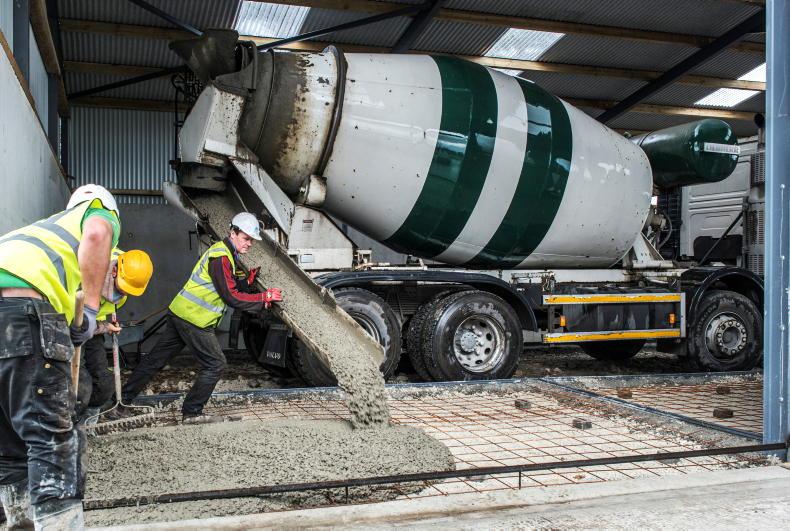
Every time a full load of concrete comes in to the yard, you can expect a bill of €1,200+ VAT /Michael Mc Laughlin.
Should an additional 70l (0.7m2) per cow per week be required, then there’s an additional 151,200l (151.2m2) that will have to be built.
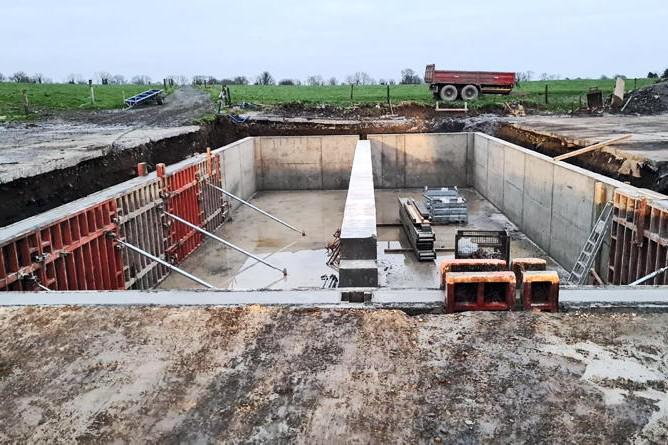
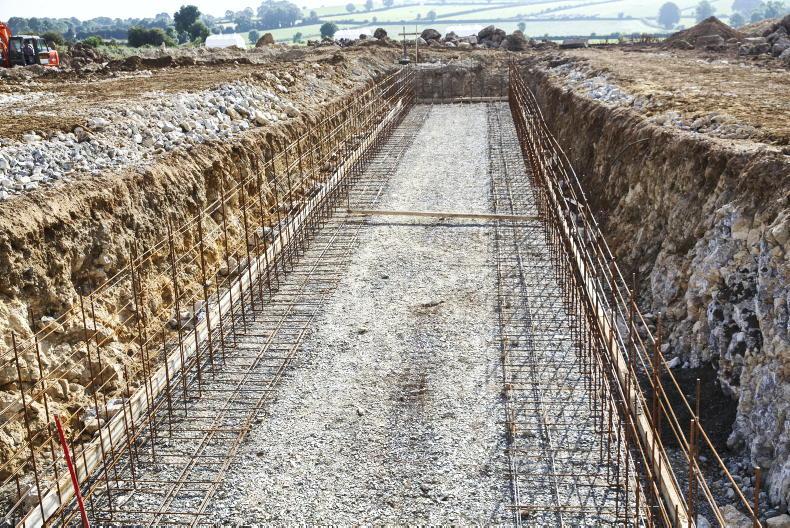
Constructing a three-bay tank (4.8m bays) with agitation points at either end overlayed with a 14ft 6in slat at 2.4m deep, will give an approximate usable capacity of 168.4m2, which will tick the box on the above additional requirement.
However, this figure is for tanks that are roofed over and not receiving any rainfall. If the farmer currently has sufficient cubicle accommodation for their animals, then this tank will likely remain unroofed and the rainfall for the closed period will have to be taken in to consideration. The Athenry weather station has a long-term average of 431.6mm of rainfall between October and mid-January, the depth of which will have to be excluded from our tank, as will an additional 100mm of freeboard.
Taking the above rainfall and freeboard into account, our tank will have to extend to three 6m long bays, with agitation points at either end to measure 21m in length.
TAMS reference costs put the cost of this tank at €22,265.49 plus VAT. The likelihood is that most farmers will try and avail of TAMS aid for it, which will net in a grant amount of €13,359.30.
Accounting for a discrepancy of 20% between the reference and actual costs of construction, the farmer should be looking at a cost of approximately €13,359.30, or €111/cow. This is, however, an open tank, and farmers will have to invest further money in either fencing around it or, in most cases, overlaying with slats to work as a feed area, etc.
What will happen now?
The year-two data should hopefully be released in the next few months, and we may better judge what line of action the Department will take then.
While the separate ceiling and increased grant rate for slurry storage was launched in January of this year, there is the distinct possibility that funding for the remainder of TAMS III could be tight, so look to get your application in relatively quickly.
The unfortunate thing about this is that we are still waiting to be granted an exemption on planning for slurry storage, which would allow farmers to create up to 1,000m2 of one-off storage. It is currently gone to the cabinet for debate.
What I would advise some farmers who are significantly lacking storage, even at current levels, is to get up to spec quickly before the goal post is moved further away. Current TAMS legislation means that farmers who have insufficient storage on-farm at present are not eligible for grant aid to create additional slurry storage.
If you are currently sitting at 0.3m2/cow/week storage (10% behind requirement) and the minimum jumps to 0.4m2/cow/week, you will have a significant investment to complete out of your own pocket should you be inspected.
The real elephant in the room with regard to slurry storage is the derogation and where farmers will be regarding stock numbers.
Farmers are willing to spend the above but not if cow numbers are to be cut. Concrete lorries coming in to the yard will cost €1,200 at current prices, and if milk lorries aren’t going out of the yard, it is nonsensical to invest.
Slurry storage has been an issue for many years now. A lengthening of the closed period, which now runs two weeks longer than two years ago, as well as the seemingly increased variability in weather patterns has caused farmers to increase slurry storage on their farms.
Current prices of construction, difficulties in being granted planning approval and the uncertainty surrounding stock numbers has made this difficult to finance and justify.
There has been a lot of talk since the preliminary results were released last year by Teagasc with regard to slurry storage and soiled water storage on farms. Over a 12-month analysis between July 2023 and June 2024, 100 farms were monitored regarding the volumes of slurry and soiled water that they produced.
Going by those 12 months of data, the current figure of 330l/ dairy cow/week and 210l/cow/week for soiled water storage were insufficient.
The average volume of slurry collected between November and February was 413l/cow/week (including 20-40l of rainfall) while the average volume of soiled water produced in peak months, July-October and March-June, was 300l/cow/week (including 20-40l of rainfall).
What does this mean?
Teagasc was very keen to point out that this was only year-one data from a two-year study, and Dr Pat Tuohy of Teagasc, who is heading up the research, also highlighted at the Irish Farmers Journal Dairy Day in Cork last year that it was an extremely wet 12-month period, which could have affected results.
The slurry results are probably of little surprise to many farmers, as those who are tight on actual slurry storage will often find that they have sufficient storage ‘on paper’. What is likely to be surprising is the volume of rainfall entering tanks, with up to 10% of storage being lost to rainfall. As this study has been commissioned by the Department, the year-two results will likely have a major impact on what will happen regarding Departmental figures for minimum slurry storage.
With regard to soiled water storage, it is something that farmers should be less fearful of, as the peak months listed in the report are not within the closed period. The report actually shows that the mean volume of soiled water collected on 9 December, (the closed period for soiled water spreading) was less than 150l/cow/week, while the figure for January was just 50l/cow/week. With current figures for all farmers being 210l/cow/week, it seems that the current regulatory figures more than cover the requirements.
What will this cost farmers?
Regarding soiled water storage, it is likely to not cost farmers who currently have sufficient storage at the 210l mark anything, provided the Department uses common sense and sees that there is no need to base figures off peak milk months. I would suspect that the year-two data will show little change, and possibly a decrease in collected volumes if anything, when it is released.
Slurry storage will be a different issue if it arises. We will take a 120-cow herd based in Co Galway as an example and exclude youngstock for simplification. At 330l/cow/week (0.33m2) and a closed period of 18 weeks, this farmer will require 712,800l (712.8m2) of slurry storage to be compliant, which they are at the minute.
Every time a full load of concrete comes in to the yard, you can expect a bill of €1,200+ VAT /Michael Mc Laughlin.
Should an additional 70l (0.7m2) per cow per week be required, then there’s an additional 151,200l (151.2m2) that will have to be built.
Constructing a three-bay tank (4.8m bays) with agitation points at either end overlayed with a 14ft 6in slat at 2.4m deep, will give an approximate usable capacity of 168.4m2, which will tick the box on the above additional requirement.
However, this figure is for tanks that are roofed over and not receiving any rainfall. If the farmer currently has sufficient cubicle accommodation for their animals, then this tank will likely remain unroofed and the rainfall for the closed period will have to be taken in to consideration. The Athenry weather station has a long-term average of 431.6mm of rainfall between October and mid-January, the depth of which will have to be excluded from our tank, as will an additional 100mm of freeboard.
Taking the above rainfall and freeboard into account, our tank will have to extend to three 6m long bays, with agitation points at either end to measure 21m in length.
TAMS reference costs put the cost of this tank at €22,265.49 plus VAT. The likelihood is that most farmers will try and avail of TAMS aid for it, which will net in a grant amount of €13,359.30.
Accounting for a discrepancy of 20% between the reference and actual costs of construction, the farmer should be looking at a cost of approximately €13,359.30, or €111/cow. This is, however, an open tank, and farmers will have to invest further money in either fencing around it or, in most cases, overlaying with slats to work as a feed area, etc.
What will happen now?
The year-two data should hopefully be released in the next few months, and we may better judge what line of action the Department will take then.
While the separate ceiling and increased grant rate for slurry storage was launched in January of this year, there is the distinct possibility that funding for the remainder of TAMS III could be tight, so look to get your application in relatively quickly.
The unfortunate thing about this is that we are still waiting to be granted an exemption on planning for slurry storage, which would allow farmers to create up to 1,000m2 of one-off storage. It is currently gone to the cabinet for debate.
What I would advise some farmers who are significantly lacking storage, even at current levels, is to get up to spec quickly before the goal post is moved further away. Current TAMS legislation means that farmers who have insufficient storage on-farm at present are not eligible for grant aid to create additional slurry storage.
If you are currently sitting at 0.3m2/cow/week storage (10% behind requirement) and the minimum jumps to 0.4m2/cow/week, you will have a significant investment to complete out of your own pocket should you be inspected.
The real elephant in the room with regard to slurry storage is the derogation and where farmers will be regarding stock numbers.
Farmers are willing to spend the above but not if cow numbers are to be cut. Concrete lorries coming in to the yard will cost €1,200 at current prices, and if milk lorries aren’t going out of the yard, it is nonsensical to invest.







SHARING OPTIONS