


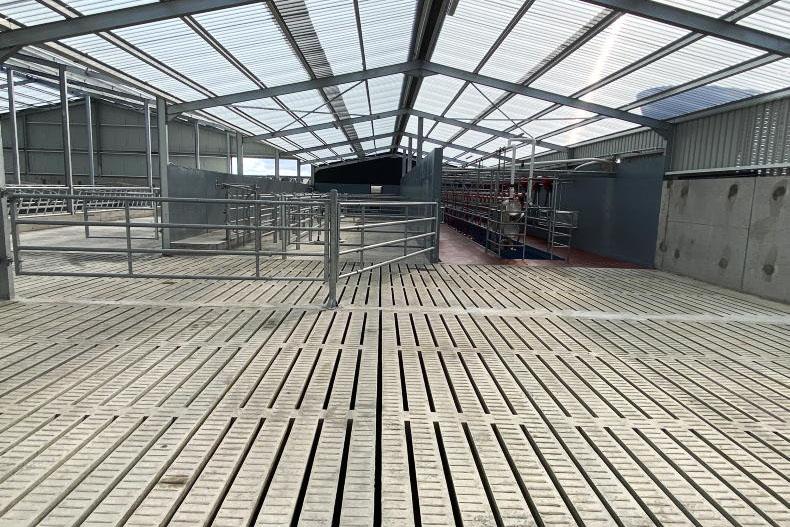
In mid-2023, Teagasc began a survey on 100 dairy farms across the country to assess the volume of both slurry and soiled water collected – with the data from the two-year monitoring programme recently published.
The survey stemmed from the Department of Agriculture, Food and the Marine (DAFM) requesting in late 2022 that Teagasc outlines a methodology to assess current volumes of dairy soiled water (DSW) and slurry produced on dairy farms.
The 100 farms were selected to account for variability in location, climate, scale, stocking density and developmental stage, and be representative of the wider dairy sector, stated Teagasc.
Results for slurry
The data was presented based on peak (December of each year) stock numbers contributing to each tank as equivalent average per cow, per week figures, as such it illustrates the changes in housing rate over the year, as well as the influence of other sources outside of the housing period.
From November 2023 to February 2024 (the peak housing period in that winter), the mean volume collected was 413.8l/cow/week.
For December 2024 and January 2025 (the peak housing period in that winter), the mean volume collected was 404.1l/cow/ week.
Over winter (November to February) slurry volumes collected amounted to 7034.1l/cow in the first winter and 6062.4l/cow in the second winter of the study.
The above 2024/2025 figures show the peak volume collected in what was an extremely dry winter. However, if we use the total figures given for 2024/2025 (6062.4 l/cow) and divide by 17 weeks (as they done for the 2023/2024 figures), the average across those 17 weeks is 356.58l.
If we add the 413.8l/cow/week from 2023/2024 and the 356.58l/cow/week from above, we have an average of 385.19l, which comes to a 16.7% increase.
With winter 2023/2024 being exceptionally wet and winter 2024/2025 being exceptionally dry, I would say the above 385.19l is a fair representation, but it would be open to interpretation by the Department.
The conclusion of the survey notes that while there were significant variances in the weather in year one and year two, there was no significant variance between the volumes collected at the peak housing period for each of the two years, at just 9.7l/cow/week.
It also highlighted the fact that the current regulations of 330l/cow/week (0.33m³) had been in place since the beginning of the implementation of the derogation, which was back in 2006, with no increase in storage requirements despite increases in production per cow since then.
Soiled water results
Data from soiled water tanks is again available by scanning the QR code. The data was again presented based on peak cow numbers milked each year and includes all sources.
The mean volume collected across the study period was 249.9l/cow/week. However, the volume of soiled water collected in the closed period (month of December) was less than 150l/cow/week for 2023 and just approximately 210l/cow/week for 2024.
The likelihood for this is that farmers milked on cows in 2024 later than in 2023 owing to good weather and increased milk prices. As such, the current legislation of 210l (0.21m³) appears sufficient, as the volumes collected in the closed period are at or below the current requirements.
What does this all mean?
This was a very thorough and much needed survey and a hat tip must go to Patrick Tuohy and his team in Teagasc Moorepark for their work on this. In reality we all knew that the 330l/cow/week wasn’t sufficient with current production levels, and the survey has shown exactly this.
What we now have to wait and see is how exactly the Department interprets and implement any changes on minimum requirements based off these results.
Does it use the peak housing period volumes recorded across the two years at an average of 408.95l/cow/week and use it across the whole closed period?
I think it would be on the unfair side to do this, as a good deal of grazing will occur within the closed period of a normal year.
A fairer and more manageable increase would be to bring the minimum storage up to 356.58l/cow/week, which represents an increase of 16.7% instead of 23.9%.
If the Department does implement any changes, it would be expected that a phasing in period to allow farmers to get up to spec, while still being compliant to apply for grants, would be put in place.
Click here to to access the Final Data Summary
July 2023-March 2025 for slurry and dairy soiled water volume
estimates




SHARING OPTIONS